01
Ice machines need descaling more often than the manual says
What it points to: Hard water is coating the evaporator. Softening or scale-control filtration on the ice machine supply addresses the cause.
Open 24/7Open 24 hours a day, 7 days a week · Since 1981Family owned in Mesa since 1981
(480) 969-3193Commercial service · Softening and filtration
Commercial softening and filtration for Mesa businesses, sized to protect the ice machines, dishwashers, water heaters and fixtures that hard water wears out first.
In one sentence
Commercial water treatment is softening, filtration or reverse osmosis sized for a business's flow and equipment, installed to reduce scale, sediment or taste problems before the water reaches the appliances that depend on it.
What hard water costs a business
Hardness does not shut a building down. It shortens the life of every appliance that heats or chills water, and it does it quietly until a part fails. In a commercial building the fixture count multiplies the effect.
12-22
grains per gallon
Typical hardness of City of Mesa water, depending on which source is serving the area.
Source: City of Mesa, water quality information
Scale coats the evaporator plate, slows harvest and triggers more frequent descaling.
Scale builds in boilers and lines, and it changes how the drink tastes.
Spotting on glassware, scaled heating elements and wash arms that clog.
Sediment settles on the tank floor and insulates the burner from the water it is heating.
Restricted flow and valves that stick open or run on, multiplied by every restroom.
Evaporative equipment and misters scale over fastest of all.
Reading the building
One fixture misbehaving is a fixture. The same complaint arriving from several places, or on a schedule, is the building telling you where to look, and it is the most useful thing to describe on the call.
What it points to: Hard water is coating the evaporator. Softening or scale-control filtration on the ice machine supply addresses the cause.
What it points to: Minerals left behind as the rinse water dries. Softer water rinses clean with less chemical.
What it points to: Scale on diaphragms, seats and solenoids. The fixture count multiplies the repair bill.
What it points to: Chlorine or dissolved solids rather than hardness. Carbon filtration or reverse osmosis at the point of use is the usual answer.
What is in these buildings
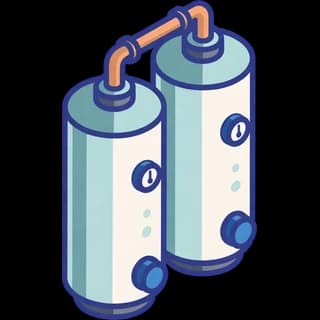
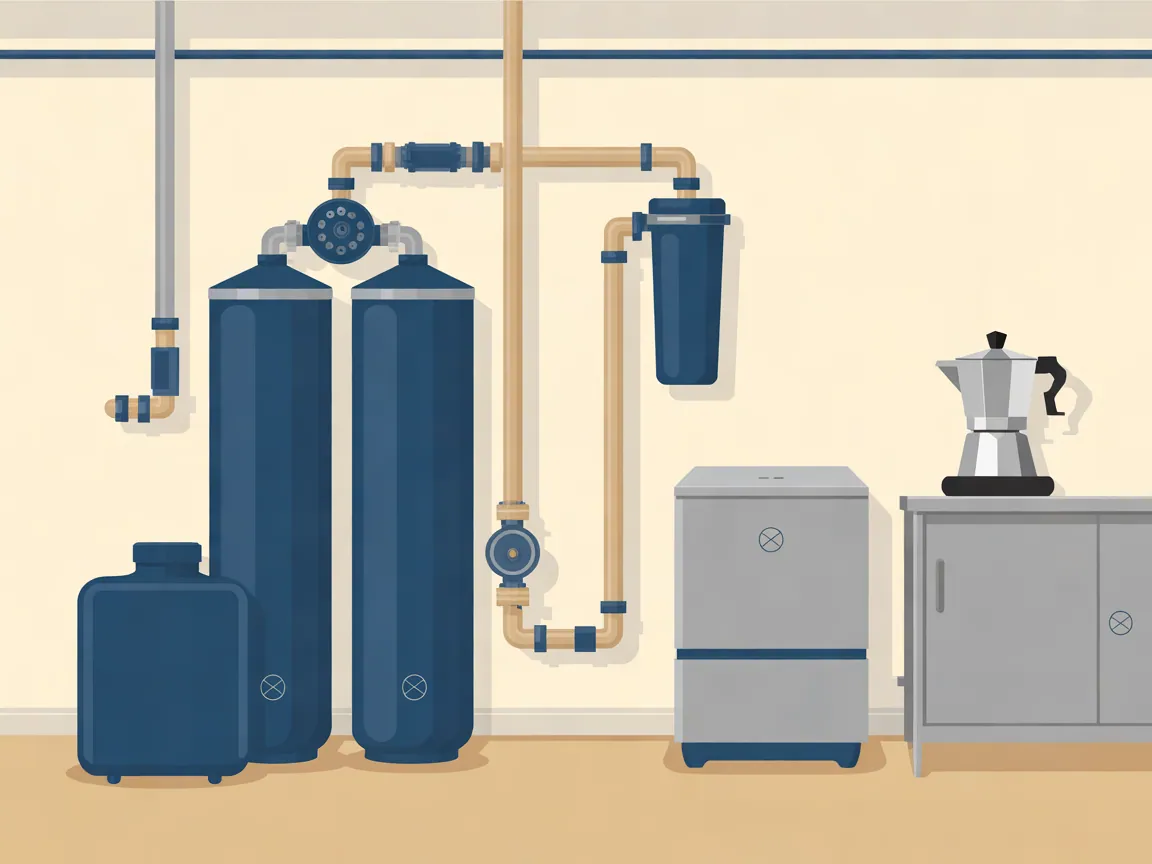
One tank serves while the other regenerates, so a business that runs all day never draws hard water during a regeneration.
Sediment filters protect valves and equipment; carbon reduces chlorine taste and odor for beverage and ice.
Purified water for drinking, coffee or equipment that calls for it, sized for that one use rather than the whole building.
When it is stopping the business
Start with what it is doing to the business, then the equipment involved. Open 24 hours a day, 7 days a week; timing gets settled on the call.
The sequence
Step 1
Hardness, flow rate and daily volume decide the size of a softener, and a softener that is too small runs out mid-shift.
Step 2
Whole building, a hot water loop, or specific equipment. Not every line needs softening, and drinking water may need different treatment.
Step 3
Every system goes in with a bypass so water keeps flowing during service or regeneration problems.
Step 4
Salt, filter changes and resin life set on a schedule matched to the site's use.
Worth knowing before you call
Hard water does not shut a business down. It shortens the life of every appliance that heats or chills water, slowly enough that the cost hides in repair invoices and descaling chemicals. JB Water & Air has treated water in the Valley since 1981, and the licensed entity's legal name, J B Sales & Water Distillers LLC, still reflects where the company started.
The City of Mesa reports hardness typically between 12 and 22 grains per gallon depending on which source is serving the area. A household feels that as spots on glass and scale on a showerhead. A business feels it across every ice machine, coffee brewer, dishwasher, water heater and flush valve in the building, all scaling at once. Hard water stains in Mesa shows what the minerals leave behind.
The useful comparison is not the cost of a softener against nothing. It is the cost of treatment against the descaling, part replacements and early equipment failures it prevents, measured on your own repair log.
A commercial system does not have to treat every drop. Softening the hot water loop protects the water heaters and the fixtures that use hot water. A dedicated filter or softened line protects an ice machine or espresso machine. Drinking water may call for carbon filtration or reverse osmosis at the point of use instead. Deciding where the water goes first keeps the system the right size.
A residential softener regenerates overnight, when nobody is using water. Many businesses do not have an overnight. Twin-tank alternating softeners keep one tank in service while the other regenerates, so the building never draws hard water mid-shift. Sizing comes from hardness, peak flow rate and daily volume, which is why the assessment starts with how the site actually uses water.
Ice machines, combi ovens, espresso machines and sterilizers often specify the water quality their warranty expects. Some call for filtration; some specify hardness limits; some call for purified water. Those requirements come first. The restaurants page and the dentist office page cover how this plays out in those two kinds of businesses.
Industries that rely on this
Kitchen drains, grease lines, hot water for sanitizing, ice machines and kitchen cooling, worked around service.
Open the pageOperatory sinks, sterilization water, water heaters and zoned cooling, scheduled around patients and coordinated with your dealer.
Open the pageShared stacks and risers, unit-by-unit HVAC and the turn schedule, handled with notice, access and records in order.
Open the pageExam room sinks, hot water held at safe temperatures, restrooms and zoned cooling for outpatient medical offices.
Open the pageTalk about the property
Tell us the equipment you want to protect and how much water the site uses. The team calls back to confirm access, the permit question and a window. No price or date is promised before the survey.
A call is faster than this form for anything affecting the business: (480) 969-3193
Please call (480) 969-3193 and a team member will help with your service request. Open 24 hours a day, 7 days a week.
Call (480) 969-3193Open 24 hours a day, 7 days a week.
Questions people ask
List the equipment that keeps scaling up and how often it gets descaled. Call, or send the details and the team will call back.
ROC #260511 · ROC #341937 · CR-77 plumbing & CR-39 air conditioning. Open 24 hours a day, 7 days a week.