01
Hot water runs out at the same time every day
What it points to: The system meets the average and misses the peak. More storage, faster recovery or a second heater fixes it; a bigger version of the same tank may not.
Open 24/7Open 24 hours a day, 7 days a week · Since 1981Family owned in Mesa since 1981
(480) 969-3193Commercial service · Hot water systems
Commercial tank, tankless and multi-heater systems in Mesa, repaired or replaced and sized to the hour your property actually peaks, not to the model that came out.
In one sentence
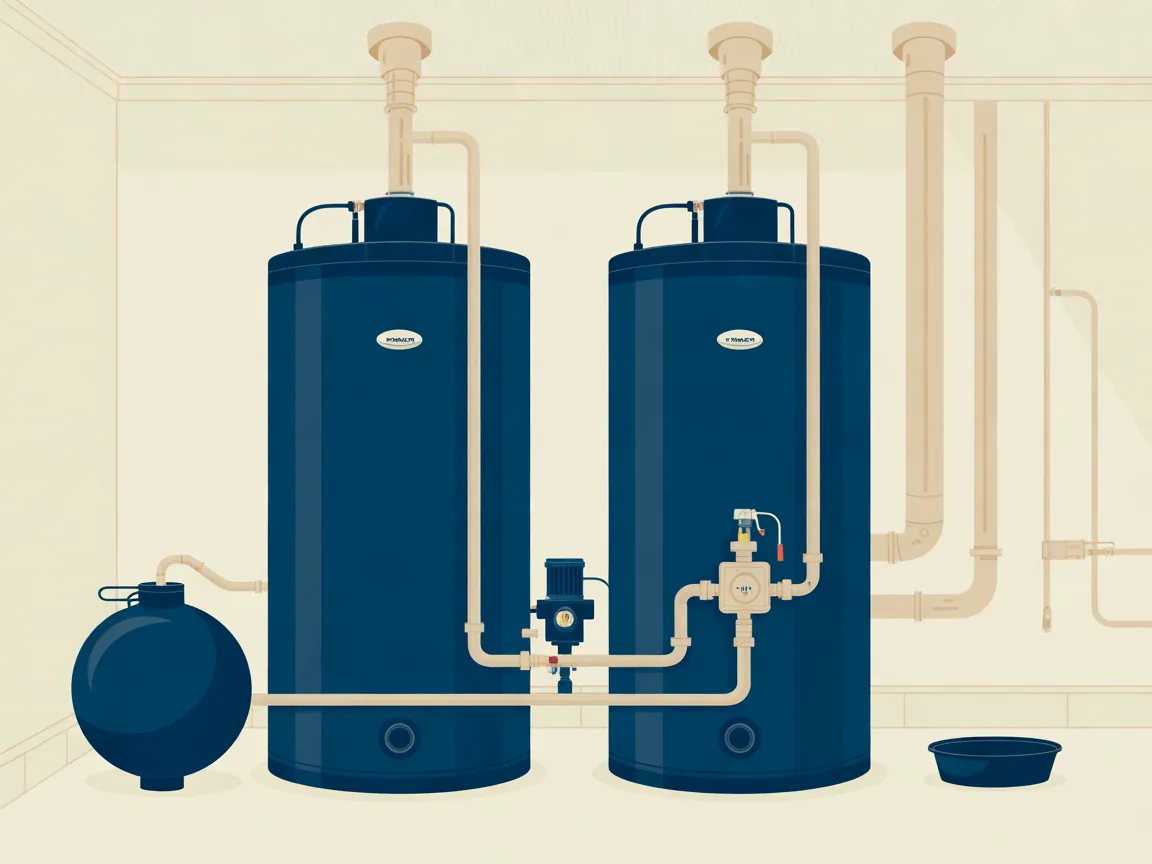
A commercial water heater is a high-capacity tank, tankless or multi-unit system that supplies hot water to a business, sized by peak demand and recovery rate rather than by the number of bathrooms.
Reading the building
One fixture misbehaving is a fixture. The same complaint arriving from several places, or on a schedule, is the building telling you where to look, and it is the most useful thing to describe on the call.
What it points to: The system meets the average and misses the peak. More storage, faster recovery or a second heater fixes it; a bigger version of the same tank may not.
What it points to: The recirculation loop is off, failed or unbalanced, so water cools in the pipe between uses.
What it points to: Hard water sediment on the tank floor. In Mesa it builds fast, and it insulates the burner from the water it is heating.
What it points to: A leaking tank cannot be repaired. A discharging relief valve can mean excess pressure or temperature, or a failed expansion tank.
Sizing to the peak
A commercial heater fails its job when the peak arrives, not when the average does. Each kind of property peaks differently, which is why the replacement is sized from how the building is used rather than from the old unit's data plate.
When it is stopping the business
Start with what it is doing to the business, then the equipment involved. Open 24 hours a day, 7 days a week; timing gets settled on the call.
What is in these buildings
High input and large storage, the workhorse for kitchens and multifamily plants. Venting and gas supply sizing matter as much as the tank.
Several units staged together can match a varying load. Hard water makes descaling part of the maintenance plan.
Let storage run hot enough to limit bacterial growth while delivering a safe temperature at the tap.
Keep hot water close to distant fixtures. A timer or controls stop the loop wasting energy after hours.
The sequence
Step 1
Capacity, input, age and fuel, set against the fixtures it serves and when they peak.
Step 2
Burner or element, controls, venting, recirculation or the tank itself, tested rather than assumed.
Step 3
When replacement is the answer, size it to the peak, check the gas or electrical service and venting, and plan the swap around your hours.
Step 4
Storage and delivery temperatures recorded on completion, with mixing valves set for a safe tap temperature.
Worth knowing before you call
Commercial water heater work in Mesa is performed by JB Water & Air under Arizona ROC #260511, CR-77. Gas supply and venting for the heater fall under the same license. The company is open 24 hours a day, 7 days a week.
A commercial water heater rarely fails at its job on an average day. It fails in the busiest hour: the dish cycle after the dinner rush, the morning shower window in an apartment building, the run of patients washing hands at a clinic. Replacing a failed heater with the same model only works if that model was sized right in the first place, and in many buildings it was not, or the use of the building has changed since.
Two numbers decide whether a system keeps up: how much hot water it stores, and how fast it recovers. A smaller tank with a high-input burner can outperform a larger tank with a slow one. Several staged heaters can follow a load that rises and falls through the day. What you need to know when replacing a water heater covers the basics for a single unit.
Mesa's water typically runs 12 to 22 grains per gallon of hardness according to the City of Mesa. As water heats, those minerals fall out as sediment on the tank floor, where they insulate the burner from the water and make the tank work harder. Flushing on a schedule slows the buildup. In a heavy-use building, commercial water treatment upstream of the heater can protect it along with every other appliance that heats water.
Stored hot water has two jobs that pull against each other. It needs to be hot enough to limit bacterial growth, and it must not scald someone at the tap. Thermostatic mixing valves solve that by storing hot and delivering tempered. In medical and dental offices, restaurants and apartment buildings, the setting of those valves matters, and it should be recorded when the system is serviced.
A commercial heater swap involves the gas or electrical service, the venting, the condensate on high-efficiency units, the expansion tank, the recirculation loop and the space to get the old unit out. Each of those should be in the scope. The residential water heater page explains the single-unit decisions, and the gas line page explains when a larger heater needs a larger gas supply.
Industries that rely on this
Kitchen drains, grease lines, hot water for sanitizing, ice machines and kitchen cooling, worked around service.
Open the pageShared stacks and risers, unit-by-unit HVAC and the turn schedule, handled with notice, access and records in order.
Open the pageExam room sinks, hot water held at safe temperatures, restrooms and zoned cooling for outpatient medical offices.
Open the pageOperatory sinks, sterilization water, water heaters and zoned cooling, scheduled around patients and coordinated with your dealer.
Open the pageTalk about the property
Tell us the heater, the property, and when the hot water runs out. The team calls back to confirm access, the permit question and a window. No price or date is promised before the survey.
A call is faster than this form for anything affecting the business: (480) 969-3193
Please call (480) 969-3193 and a team member will help with your service request. Open 24 hours a day, 7 days a week.
Call (480) 969-3193Open 24 hours a day, 7 days a week.
Questions people ask
Send the heater's data plate and the hour the hot water fails, or call and describe it. The team will call back to plan the visit.
ROC #260511 · ROC #341937 · CR-77 plumbing & CR-39 air conditioning. Open 24 hours a day, 7 days a week.